Español
 Português
What Happened in the High-Speed US-19 Rollover?
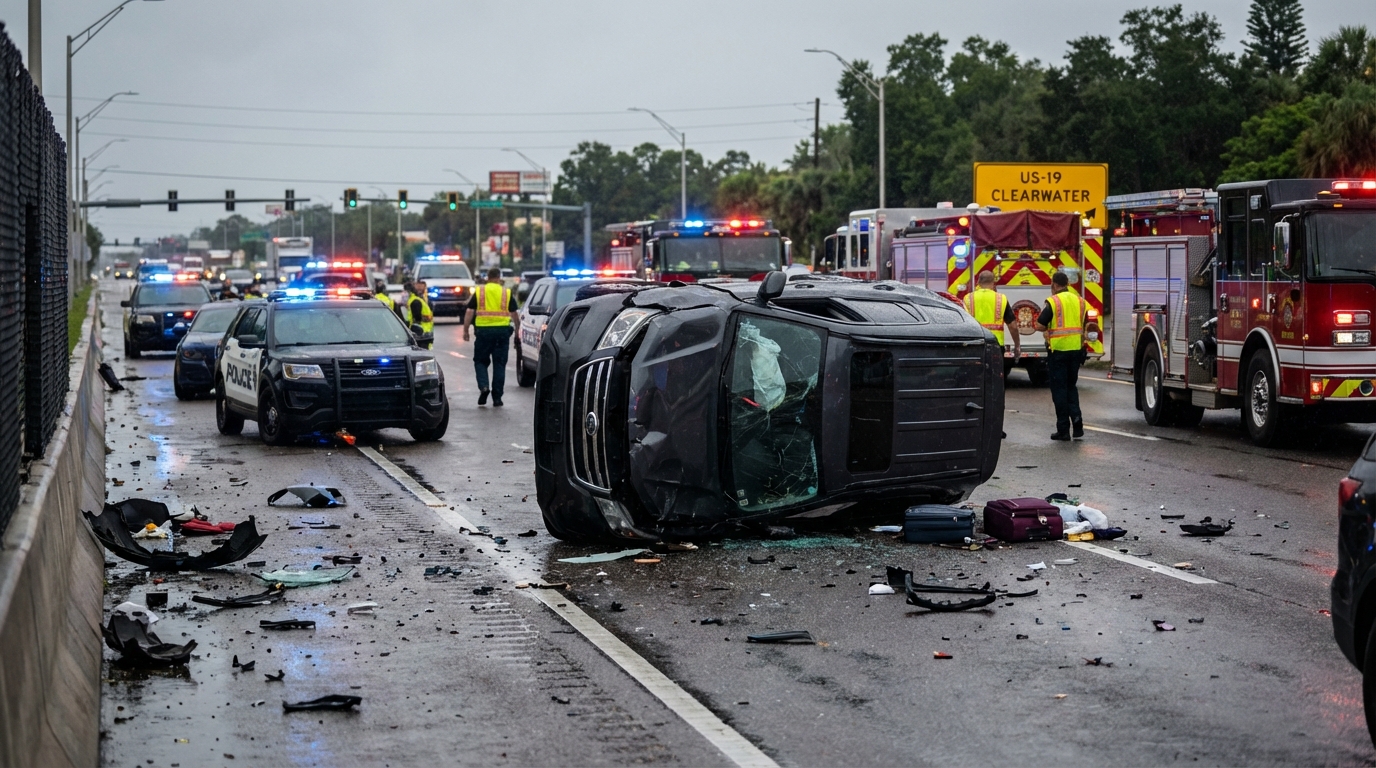
A violent high-speed rollover crash on US-19 in Clearwater left a 20-year-old man fighting for his life on the afternoon of April 14, 2026. The accident occurred near the intersection of US-19 and Sunset Point Road, a notoriously busy stretch of highway in Pinellas County. According to the Florida Highway Patrol (FHP), the young man was operating an SUV at a high rate of speed when he lost control of the vehicle, causing it to veer off the roadway and flip multiple times.
Witnesses reported seeing the vehicle tumble across several lanes before coming to a rest in a mangled heap. During the rollover, the driver was ejected from the vehicle, landing a significant distance away on the pavement. Emergency responders arrived quickly and transported the victim to a local trauma center in critical condition. The force of the crash and the subsequent ejection highlight the extreme dangers associated with high-speed travel and the critical importance of vehicle safety systems.
Details of the Clearwater Crash Investigation
The Florida Highway Patrol is leading the investigation into the cause of the rollover. Preliminary evidence suggests that excessive speed was a primary factor in the driver losing control. Investigators are also examining the vehicle for any signs of mechanical failure, such as a tire blowout or steering malfunction, which can be catastrophic at high speeds. The stretch of US-19 where the crash occurred is known for its heavy traffic and complex lane configurations, making it a frequent site for serious collisions.
A key focus of the investigation is whether the driver was wearing a seatbelt. Ejection from a vehicle during a rollover is almost always a result of a seatbelt not being fastened or failing under extreme pressure. FHP’s Traffic Homicide Unit, which handles both fatal and life-threatening injury crashes, is meticulously reconstructing the scene to determine the exact sequence of events. They are also reviewing dashcam footage from other motorists who witnessed the harrowing accident.
Common Causes of Serious Florida Rollover Accidents
Rollover accidents are among the most lethal types of crashes on Florida’s roads. While any vehicle can roll over, SUVs and trucks are particularly susceptible due to their higher center of gravity. Common causes include:
- Excessive Speed: Speeding makes it much easier for a driver to lose control during a sudden maneuver, such as swerving to avoid an object or another vehicle.
- Tripping: Most rollovers occur when a vehicle’s tires leave the pavement and ‘trip’ on soft soil, a guardrail, or a curb, causing the momentum to flip the vehicle.
- Distracted Driving: A driver who is distracted may make a sudden, jerky steering correction when they realize they are drifting, which can initiate a rollover.
- Tire Blowouts: A sudden loss of tire pressure at high speeds can cause a vehicle to pull sharply to one side, leading to a loss of control and potential flipping.
- Impaired Driving: Alcohol and drugs slow reaction times and impair the coordination needed to safely navigate high-speed highways.
- Aggressive Maneuvers: Rapid lane changes or sharp turns at high speeds are frequent triggers for rollover incidents.
Florida Personal Injury Law and Serious Injury Claims
When a person is critically injured in a crash like the one on US-19, the legal and financial consequences are immense. Florida operates under a ‘no-fault’ insurance system, where Personal Injury Protection (PIP) insurance provides up to $10,000 for medical bills and lost wages. However, in cases of ‘permanent injury’ or life-altering trauma, victims have the right to step outside the no-fault system and pursue a claim against any negligent parties for full compensation.
In a single-vehicle rollover, liability can be complex. While it may seem the driver is solely at fault, an investigation might reveal that a defective tire, a mechanical failure, or even dangerous road design contributed to the accident. If another driver’s actions forced the SUV off the road, that driver could also be held liable. Florida’s comparative negligence laws allow for a recovery of damages even if the victim was partially responsible, though the total award would be reduced by their percentage of fault.
What Victims and Families Should Do After a Critical Crash
The days following a critical injury accident are overwhelming. Taking these steps can help protect your legal rights while you focus on recovery:
- Prioritize Medical Care: Follow all doctor’s orders and keep detailed records of all treatments, surgeries, and rehabilitation efforts.
- Secure the Vehicle: The crashed vehicle is a crucial piece of evidence. It should be preserved in its post-crash state so that experts can inspect it for mechanical defects.
- Obtain the FHP Report: Ensure you get a copy of the official crash report as soon as it is finalized by investigators.
- Document Everything: Keep a journal of the victim’s recovery process, including pain levels and the impact on their daily life.
- Contact a Specialized Attorney: Serious injury cases require a lawyer who understands the medical and technical complexities of high-speed rollover crashes.
How Accident Cases Are Investigated by Campione Law
At Campione Law, we go far beyond the surface-level details provided in a police report. We understand that a young life changed in an instant requires a relentless pursuit of the truth. Our investigative process includes:
- Mechanical Inspections: We hire automotive engineers to inspect the vehicle for steering, brake, or tire failures.
- Accident Reconstruction: We work with specialists who use computer modeling to determine the exact speed and trajectory of the vehicle.
- Electronic Data Analysis: We retrieve data from the vehicle’s ‘black box’ to see the driver’s inputs in the seconds before the crash.
- Medical Expert Consultations: We work with top medical experts to accurately project the long-term costs of care for critical injuries.
- Witness and Video Canvassing: We proactively seek out dashcam footage and witness statements to build a complete picture of the accident.
Frequently Asked Questions (FAQ)
Can I sue if I was the only vehicle involved in a rollover?
Possibly. If the rollover was caused by a defective vehicle part (like a tire blowout) or dangerous road conditions, you may have a claim against the manufacturer or the government entity responsible for the road.
What if I wasn’t wearing a seatbelt?
In Florida, not wearing a seatbelt can be used as evidence of comparative negligence, which might reduce your compensation. However, it does not automatically prevent you from filing a claim if other factors caused the crash.
How much is a serious injury case worth?
The value depends on the severity of the injuries, the cost of past and future medical care, lost earning capacity, and the level of pain and suffering. Every case is unique.
How long will the investigation take?
A thorough FHP investigation into a critical crash can take several months. Our team conducts a parallel investigation to ensure no evidence is lost or overlooked.
What are ‘economic’ vs ‘non-economic’ damages?
Economic damages cover tangible losses like medical bills and lost wages. Non-economic damages compensate for intangible losses like pain, suffering, and loss of enjoyment of life.
Why do I need a lawyer if the insurance company is already paying?
Insurance companies often offer settlements that cover immediate costs but fail to account for the lifelong impact of a critical injury. A lawyer ensures you are fighting for the full value of your claim.
Contact Campione Law Today
If you or a loved one has been critically injured in a Clearwater accident or anywhere in Florida, Campione Law is ready to stand by your side. We provide the aggressive and compassionate representation necessary to navigate the complexities of serious injury litigation. Your recovery is our priority.
Phone: 904-990-8400
Email: [email protected]